
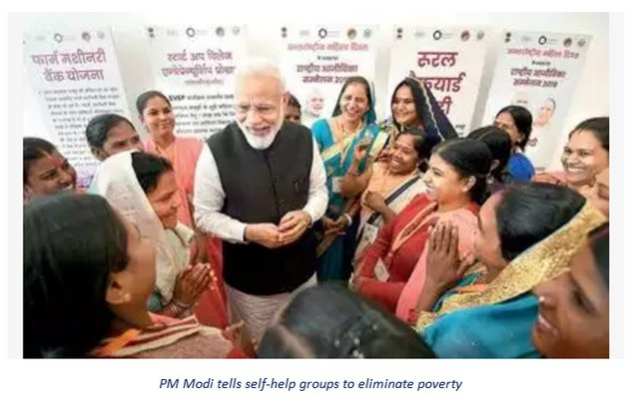
Overview – SHG
Self-help Groups (SHGs) are unofficial gatherings of people who collaborate to discover solutions to their housing issues.
It can be described as a self-governing, peer-controlled information group of individuals with a comparable socioeconomic background and a desire to work together to accomplish a common goal. It is a group of local women between the ages of 18 and 50 that acts as a financial mediator.
Over a few months, members make small, monthly savings contributions in order to build up the group's capital to the point where lending can start. The money might subsequently be repaid to the members or to other villagers for whatever reason. In India, a large number of SHGs are "connected" to banks in order to receive microcredit.
Overview – JLG
The National Bank for Agriculture and Rural Development (NABARD), a rural development organization in India, developed the idea of Joint Liability Groups (JLGs) in 2014 to offer institutional finance to small farmers.
Joint Liability Groups (JLGs) have contributed significantly to the advancement of the materialistic, unbanked, poor society's path to self-sustainability by facilitating access to formal financial services with the suggestion of self-employment, which has long been their unfulfilled desire.
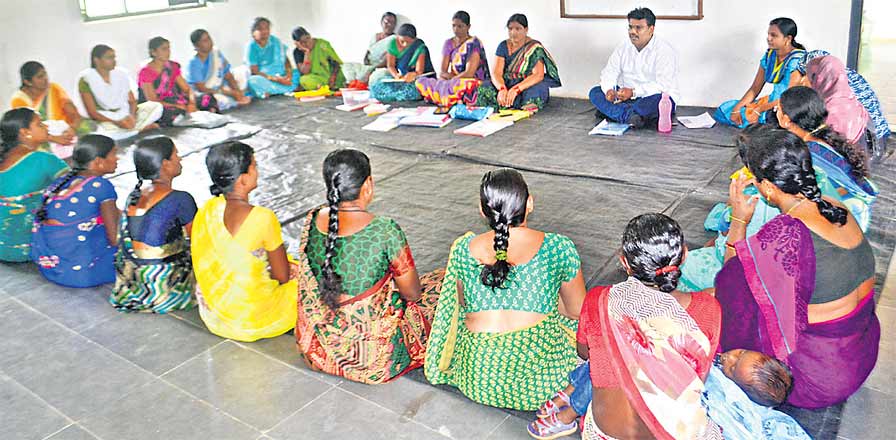
In order to obtain a loan from a bank without providing any collateral, a Joint Liability Group (JLG) is made up of four to ten individuals from the same town or locality who shares a similar socioeconomic background.
Origin and Development of SHG’s in India
-
The Self Employed Women's Association (SEWA) in Ahmadabad, which worked with underprivileged, independent women in the unorganized sector, established the first SHGs in India in 1972. SEWA made an effort to assist these women in finding employment, a source of income, and food security.
-
In order to increase their wages, Ela Bhatt, who founded SEWA, organized low-wage and independent female workers such as weavers, potters, hawkers, and others in the unorganized sector.
-
There were early attempts at self-organization. For instance, the Textile Labour Association (TLA) of Ahmadabad established a women's section in 1954 to teach the women in mill worker family’s skills like knitting and sewing.
-
With the help of Muhammad Yunus' Grameen Bank, the concept of microfinance modest loans to those who are typically outside of the traditional credit net has gained popularity in Bangladesh since 1983.
-
SHGs in India were first supported by the National Bank for Agriculture and Rural Development (NABARD) in 1992, and in 1993 the Reserve Bank of India permitted SHGs to open savings accounts with banks.
-
The Government of India (GOI) launched the Swarn Jayanti Gram Swarozgar Yojana in 1999 with the goal of encouraging self-employment in rural regions through the formation and skilling of such groups. In 2011, this became the National Rural Livelihoods Mission (NRLM).
-
In existence today are State Rural Livelihood Missions (SRLMs) in 29 states and 5 UTs (except Delhi and Chandigarh).
-
The NRLM assisted the poor's access to affordable, trustworthy financial services such bank accounts, savings accounts, credit, insurance, remittances, pensions, and financial services counseling.
SHG’s Promoters
SHG's can be promoted by Retired school teacher or a retired government servant, A health worker/a field officer/staff of a development agency or State Government, Field officer or a staff member of a commercial bank/regional rural bank, Field staff from the local co-operative bank or society, An unemployed educated local person, Non-governmental agencies, Government, Poverty management Programmers, State & commercial banks, Microfinance institutions, SHG Federations, SHG leaders/Entrepreneurs, A member/participant in the Vikas Volunteer Vahini (VVV) Programme of NABARD
JLG’s Promoters
JLGs can be promoted by Business Facilitators, NGOs, Farmers' Cubs, Farmers Associations, Panchayat Raj Institutions (PRIs), Krishi Vikas Kendra’s (KVKs), State Agriculture Universities (SAUs), Agriculture Technology Management Agency (ATMA), Bank Branches, PACS, Other Co-operatives, Government Departments, Individuals, Input dealers, MFIs / MFOs, JLPI etc.
SHG’s Goals
-
The goal of SHG includes empowering women, fostering leadership among the underprivileged and needy, increasing school attendance, enhancing nutrition, and promoting the use of birth control.
-
SHGs serve as a link between people of high and low castes.
JLG’s Goals
-
The goals of JLG are to foster confidence between parties, act as a substitute for collateral, increase credit flow, reduce risks, and ensure food security.
-
To provide tenant farmers with collateral-free loans using the JLG process
Functions of SHG's are as follows
-
They work to increase the functional ability of society's disadvantaged and marginalized groups in the areas of employment and income-generating endeavors.
-
They provide collateral-free loans to groups of people who typically struggle to obtain loans from banks.
-
Additionally, they use group leadership and conversations to resolve disputes.
-
They are a crucial supplier of microfinance services to the underprivileged.
-
They serve as a conduit for official banking services to the underprivileged, particularly in rural areas.
-
Additionally, they urge the impoverished to develop a saving habit.
Features of JLG's are as follows
-
Members ought to engage in something in common.
-
Members are not required to own land.
-
They ought to be from the same village.
-
JLGs only allow one family member each family to join.
-
Members shouldn't have a history of bank loan default.
-
Members ought to meet frequently.
Benefits of SHG’s
-
SHGs encourage banks to lend to the underprivileged and excluded segments of society.
-
SHGs have given voice to societal groups that would not otherwise have one.
-
Many social evils, like dowry, alcoholism, early marriage, etc., are eliminated thanks to SHGs.
-
Through encouraging women SHGs assist in guiding the country toward actual gender equality.
-
SHGs serve as pressure groups that can be used to compel the government to take action on crucial issues.
-
SHGs aid in the implementation and efficiency improvement of government programmes.
-
SHGs help people better their current means of subsistence by offering tools and other resources, as well as by helping them earn a living by offering vocational training.
-
SHGs' financial inclusion has improved family planning, lowered child mortality rates, improved maternal health, and helped individuals battle diseases more effectively through better housing, food security, and access to healthcare.
-
SHGs increase banking knowledge and savings among the rural population.
Benefits of JLG’s
-
JLG's offer Groups Collateral-Free Loans
-
JLG's increase trust between banks and groups
-
Through group dynamics, peer pressure, credit discipline, and a cluster strategy, JLG's will reduce the credit risk.
-
JLGs improve agricultural product production and offer self-employment.
-
Individual loans from the financing bank may be accessed by the JLG group of 4 to 10 individuals.
-
JLG is also qualified to receive one loan, which may be used to meet the combined credit needs of all of its members.
Conclusion
Both SHG’s and JLG’s are mostly engaged in similar type of economic activity in Farm or Non-Farm sector and offer a joint undertaking to the Bank that enables them to avail loans.